



















A summary of the 6 key findings:
- Heat storage systems are necessary, but they are no substitute for efficiency at room level.
- Energy Efficiency First: a fundamental EU principle that is often reversed in practice.
- Non-residential buildings, such as care homes, schools, hotels, offices, and administrative facilities, waste heat every day in unoccupied spaces, at night, and on weekends.
- The thermal inertia of the building’s mass allows for temperature reductions without compromising comfort.
- Occupancy-based control reduces heating demand by up to 35 per cent, depending on the building and sector.
- Long-term seasonal storage remains a separate challenge.
The paradox between storage capacity and energy efficiency
Anyone talking about the heat transition today soon comes round to the subject of storage. There isn’t enough of it, it’s too expensive, and new capacity isn’t being added quickly enough. That is true. But this debate overlooks one aspect that offers significantly more scope for action to operators of schools and administrative buildings: if you use less heat, you also need to store less of it.
The order of priority – efficiency before infrastructure – is not just a nice principle. It is one of the few levers that a building operator can pull immediately and under their own steam, without having to wait for subsidy schemes, network operators, or storage manufacturers. Insulation and replacing the heating system are also part of this, but they require construction time and larger investments. Controlling the existing system is the lever with the shortest implementation time and the least disruption.
The heat storage problem is real, but not the main issue
The report on heat storage strategy, published by the German Energy Agency (Deutsche Energie-Agentur, dena) on behalf of the BMWK in August 2024, highlights the scale of the challenge: currently, around 114 GWh of heat storage capacity is in operation or at an advanced stage of planning in German heating networks. According to the report, demand by 2045 will be around 150 to 300 times higher than this. This scale of demand requires aquifer storage, ground-source storage, and large buffer tanks in heating networks, involving long planning periods, limited land availability, and substantial investment volumes.
However, this is a systemic problem at the network level. The day-to-day problem familiar to most building operators is a different one: heat is produced when nobody is there. It heats empty conference rooms, warms hotel corridors at night, and maintains care rooms at operating temperature whilst their residents spend hours in communal areas. This is not a storage problem. It is a control problem.
It is worth making a clear distinction between two fundamentally different tasks:
Long-term seasonal storage bridges the gap between months. In summer, solar thermal energy and industrial waste heat provide surpluses, whilst demand is at its highest in winter. Closing this gap requires infrastructure at neighbourhood level or large-scale storage facilities that can retain heat for weeks.
Short-term storage, on the other hand, covers hours or individual days and falls within the scope of action of each individual building. The aim here is not to store more but to waste less. The thermal inertia of the building’s mass helps with this: it allows the heat supply to be reduced during periods of inactivity without the room cooling down immediately. What is needed for this is not new infrastructure but a control system that knows when a room is in use and when it is not. This article focuses on the second dimension, which building operators can now control and influence.
Thermal mass as a natural buffer
Solid-built structures store heat. Concrete, bricks and heavy floors have a high specific heat capacity: they heat up slowly and cool down slowly. In practical terms, this means one thing above all: a room does not cool down immediately when the heat supply is reduced. It is precisely this thermal inertia that makes it possible to lower the temperature during periods when the space is unoccupied, without compromising comfort the next time it is in use. The heat is still there; it is stored in the building components. An occupancy-based control system utilises this flexibility, rather than heating continuously to the full temperature.
Energy Efficiency First: a fundamental principle that is often reversed in practice
The EU Energy Efficiency Directive (EED, Directive 2023/1791) enshrines the ‘Energy Efficiency First’ principle as a binding guideline for energy policy and infrastructure planning. The core idea is this: first reduce energy demand, then scale down generation and storage capacity accordingly.
The logic behind this is quite simple. Energy that is not consumed does not need to be generated, transported or stored. Reducing a building’s heating demand also reduces the need for generation and storage. When planning a new boiler, heat pump or buffer tank, the system can be designed to be correspondingly smaller and more cost-effective.
In practice, this order is regularly reversed: first the new heating system, then optimisation at some point later. The result is that you invest in a high-performance generator which subsequently supplies a poorly regulated system with a lot of surplus energy. The potential savings are left untapped.
What happens every day in a typical existing building without a control system
Non-residential and commercial buildings, such as care homes and hospitals, have a fundamentally different energy consumption profile to residential buildings. Operating hours can change on an hourly basis, occupancy rates fluctuate significantly, and entire wings of the building stand empty at weekends or during holidays. The heating system is not aware of this.
Examples of inefficient energy use that occur regularly in practice:
- Conference rooms set to full heating, even though the next meeting is not until the afternoon
- Hotel rooms remaining at a comfortable temperature after check-out until the room is reallocated
- Care home rooms are heated continuously whilst residents spend hours in communal areas
- Open windows to which the heating system does not respond; heat escapes and the boiler continues to run
- Night-time temperature reduction set once and not adjusted since, even though usage times have changed
The result: heat is generated, distributed and then lost through draughts, windows or simply due to incorrect temperature profiles, without ever having been used, let alone needed. This is neither a failure of the heat generator nor a shortfall in the supply network. It is heat wastage in its purest form and a lack of load management at room level.
A comparison of buildings with and without smart control systems
| Situation | Without control | With better.energy |
|---|---|---|
| Unoccupied rooms | Full temperature maintained at all times | Automatic reduction to setpoint |
| Open windows | Heating continues to run | Window contacts trigger immediate reduction |
| Weekends and nights | Standard time profile or manual operation | Occupancy-based control sets, automatic |
| Room changes in hotelsRoom changes in hotels | Manual adjustment by staff | PMS interface automatically transmits occupancy data |
| Consumption transparency | No overview per room | Consumption data available per room and location |
What smart room control actually achieves in existing buildings
better.energy automatically controls radiators in existing buildings based on occupancy data, time profiles and sensor technology. The technology operates via LoRaWAN and is independent of the building’s IT network. This means that neither any intervention in the heating system itself nor any IT integration is required.
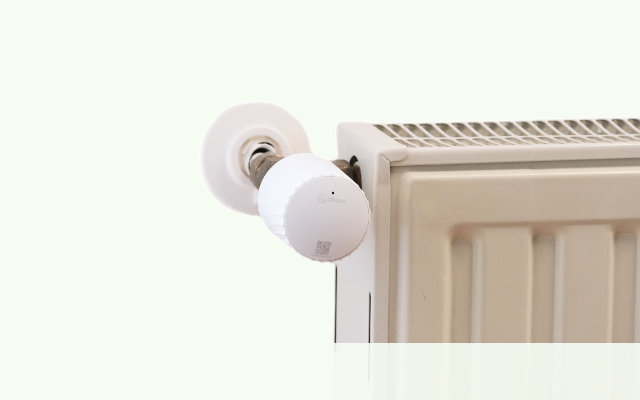
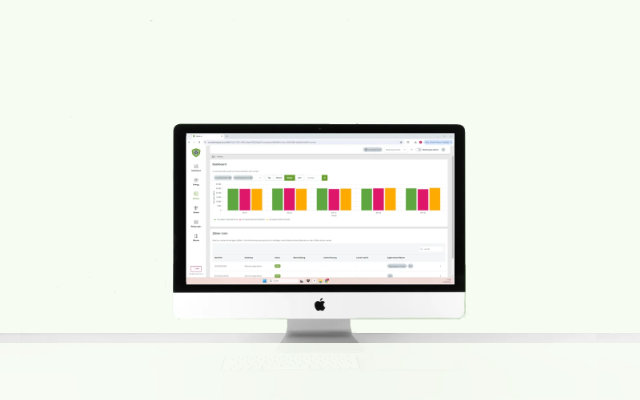
In practice, it works as follows: LoRaWAN thermostat heads are fitted onto the existing radiator valves using suitable adaptors, without any intervention in the system. Gateways receive the radio signals and transmit them to the web-based IoT platform. There, control sets are configured for each room. These specify what temperature should prevail in the room depending on occupancy levels, what happens when the room is unoccupied, and what happens when a window is opened.
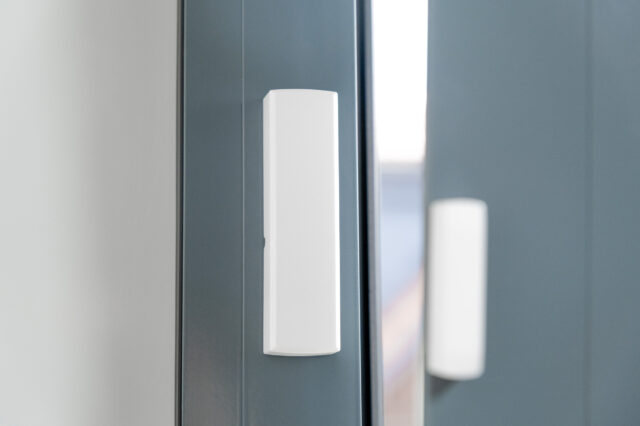
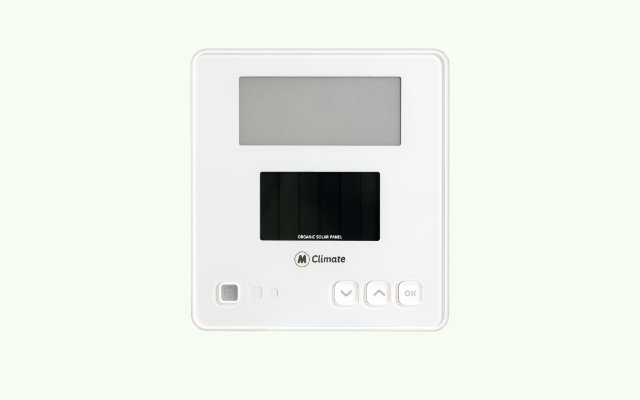
Window contacts detect when windows are open and report this to the software, which sends a command to the thermostats to close the radiator valves. This automatically lowers the temperature whilst the room is being ventilated. In hotels, the PMS interface transmits the current room occupancy status directly. In care homes, schools or office buildings, time profiles and occupancy data are stored.
Depending on the building type and initial situation, better.energy can deliver heat savings of up to 35 per cent. The exact figures depend on the consumption profile, the building structure and the condition of the existing control system. Those starting with an unregulated existing building will see the greatest benefits.
Consumption data for each room is already available on the platform today. From autumn 2026, a new module called better.energy – Analyze will be added, which systematically analyses this data and enables cross-site comparisons.

What better.energy does not solve, and when storage systems still make sense
To avoid any misunderstanding: better.energy addresses the demand side at room level. It reduces heating requirements by only heating a room when it is in use, thereby reducing the amount of heat a building needs in the first place. This is the efficiency level, not the infrastructure level. Nor is it a system for active load shifting or grid-supporting demand-side management. The approach is simpler and more direct: heat less where heating is not required.
It does not solve the seasonal storage problem. Anyone wishing to store surplus heat from solar thermal systems or industrial waste heat in summer for use in winter will need aquifer storage, district heating networks or large buffer storage tanks at neighbourhood level. This is a different class of technology, requiring different investment volumes and different planning timeframes.
Similarly, better.energy is neither a building management system nor a CAFM system. It is a specialised control system at room level that operates independently of the heat generator and complements, rather than replaces, existing heating infrastructure.
Info box: Three types of large heat storage systems
Large buffer tanks are huge, insulated water tanks that store heat through the stratification of hot and cold water. They smooth out fluctuations over periods ranging from hours to a few days and are the most mature and common design. Their sizes can reach several tens of thousands of cubic metres.
Earth-pit storage systems are large, foil-lined and covered pits filled with water or a mixture of water and gravel. Thanks to their enormous volume and low cost per cubic metre, they are suitable for seasonal storage – that is, storing summer heat for use in winter. Disadvantage: they require a large amount of space.
Aquifer storage systems utilise a natural water-bearing rock layer underground. Groundwater is heated via wells, fed into the system and extracted again in winter. They require very little surface area but do necessitate suitable subsoil conditions and water law permits. This is also a seasonal storage system.
All three operate at network and neighbourhood level and are the responsibility of district heating suppliers and local authorities, not individual building operators.
When additional heat storage systems are beneficial:
- Solar thermal systems with surplus energy during sunny hours, which would otherwise go unused
- Combined heat and power (CHP) systems where heat and electricity demand are out of sync
- District heating connections with variable tariffs, where buffer storage tanks take advantage of cheaper supply periods
- Large-scale systems where peak heat demand briefly exceeds the boiler’s rated output
- Neighbourhood schemes with a shared heat supply for several buildings
In all these cases, efficiency and storage complement one another. However, installing a storage system without first optimising efficiency results in an oversized infrastructure and unnecessarily drives up running costs.

Conclusion on heat storage and ‘Energy Efficiency First’
The storage problem associated with the heat transition is real, but it is a problem at the grid and system level. Individual building operators do not build aquifer or underground reservoir storage facilities; they wait for district heating suppliers and local authorities to build them. What they can control themselves is the consumption side. And that is precisely where the quicker and more cost-effective lever lies.
Anyone who reduces their building’s heat demand takes the strain off every level downstream: the generator, the grid and the storage facilities. This is the core of ‘Energy Efficiency First’, and it is the reason why this sequence is worthwhile. First reduce demand, then decide on additional infrastructure. Anyone who skips this step will end up with a system that is more expensive than necessary.
Would you like to find out more?
FAQ
No. Their functions are fundamentally different. A heating control system reduces heat demand by only heating when heat is needed. Heat storage tanks buffer temporary imbalances between generation and demand. The two can complement each other, but logically, efficiency comes first: if you need less, you need to store less.
According to Betterspace, the installation typically pays for itself within 1 to 3 years. The exact timeframe depends on the initial state of the heating control system, the number of rooms and the current energy tariff. Buildings with previously unregulated or poorly adjusted heating systems see the greatest benefits.
Yes. better.energy uses LoRaWAN and is therefore not dependent on Wi-Fi or a wired network within the building. The system works even without an existing IT infrastructure.
The thermostat heads are screwed onto existing valves; no work is required on the heating system itself. Depending on the size of the building, the operator can carry out the installation themselves following a briefing from Betterspace or commission a full installation service.
The battery life of the thermostatic heads is around five years. The battery level of all devices can be viewed on the platform at any time. Beyond that, no scheduled maintenance is required.
Sources and further information
- European Union: Directive (EU) 2023/1791 of the European Parliament and of the Council
- Betterspace GmbH: better.energy
- Fraunhofer-Gesellschaft; Mennel, Tim; Fischer, Tibor et al. (Deutsche Energie-Agentur dena, im Auftrag des BMWK): Gutachten zur Wärmespeicherstrategie. Berlin, August 2024
- Umweltbundesamt (Hrsg.): Wärmepumpensysteme in Bestandsgebäuden — Abschlussbericht (Climate Change 11/2024)
- Bundesministerium für Wirtschaft und Klimaschutz: Speicher für die Energiewende (Überblicksdokument zur integrierten Speicherstrategie)
- Bundesministerium für Wirtschaft und Klimaschutz: Neue Langfristszenarien für die Energiewende (Fraunhofer ISI/Consentec, Stand März 2024)