












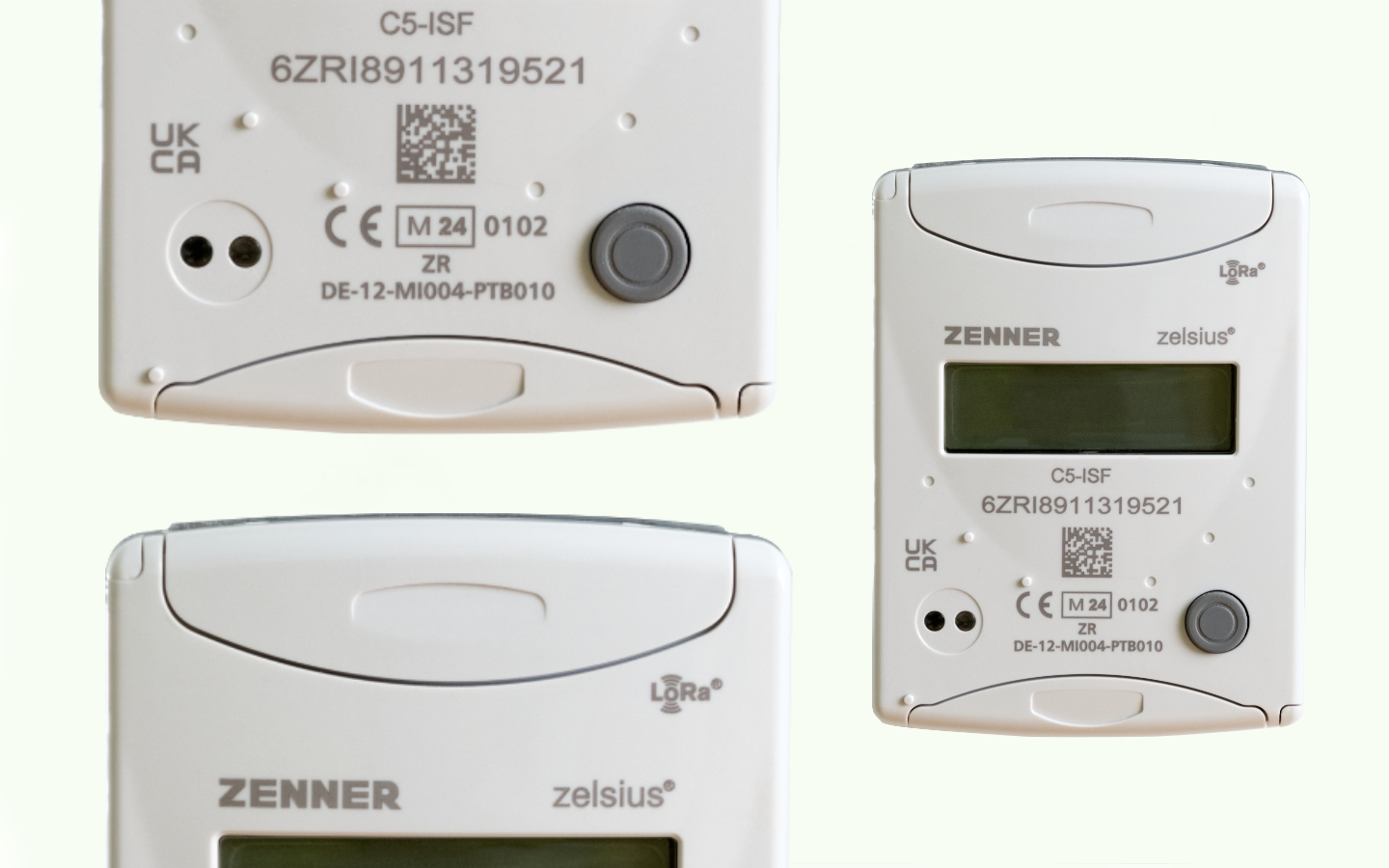
A heat meter is a measuring device that records the actual amount of heat consumed or supplied. To do this, it measures the flow rate of the heating water and the temperature difference between the supply and return pipes and uses these figures to calculate the heat energy transported. It thus provides the basic data required both for consumption-based billing and for energy monitoring in a building and, as it is relevant to billing, is subject to calibration regulations.
What is a heat meter?
A heat meter is a meter which, unlike an electricity meter, does not measure a single quantity but calculates the heat energy transferred. It is based on the volume of water that has flowed through and the temperature difference between the incoming and returning water.
As heat meters are used for billing purposes, they are subject to calibration regulations and must meet certain metrological requirements. Depending on the method of flow measurement, they are categorised as, amongst others, impeller meters, ultrasonic meters and electromagnetic induction meters. Ultrasonic meters have no moving parts, are considered to be low-wear and are therefore widely used in modern systems.
How does a heat meter work?
A flow sensor measures the water flow rate, whilst two temperature sensors measure the flow and return temperatures. The device’s processor calculates the amount of heat transferred based on the product of the flow rate and the temperature difference. Modern, wireless meters automatically transmit these values to a platform, meaning manual readings are no longer necessary. When used in conjunction with LoRaWAN, the values can also be recorded at a high temporal resolution.
The modern wireless network consists of three layers: end devices such as sensors and actuators transmit their data wirelessly to a gateway. The gateway aggregates the signals and forwards them via the internet to a network server, which makes the data available to the central application. Control commands travel in the opposite direction. Because only small data packets are transmitted in short bursts and the devices switch to a sleep mode in between, battery-powered sensors often operate for several years without needing their batteries replaced. The data is encrypted end-to-end throughout the process.
What is a heat meter used for?
Heat meters serve two purposes. Firstly, they enable billing based on actual consumption, for example, between landlords and tenants or between heat suppliers and consumers. Secondly, they provide the basic data for energy monitoring: only when heat consumption is measured can potential savings be identified and measures substantiated. Automatically readable meters eliminate the need for manual readings and enable continuous monitoring of consumption, which is particularly relevant for larger non-residential buildings subject to statutory monitoring requirements.
Another benefit lies in comparability: if several buildings or areas are monitored using calibrated meters, their consumption figures can be directly compared, and outliers become apparent. Because the devices are subject to calibration regulations, their readings are also reliable for billing purposes, which sets them apart from simple estimates or calculated allocations. This provides a reliable basis for comparisons and for prioritising measures, particularly where there are multiple sites.
Related terms
Sources and further information
- Betterspace: Smart Metering: Effizienzsteigerung durch intelligente Verbrauchsmessung und Monitoring
- Betterspace: Effiziente Wärmeverbrauchsmessung für Nichtwohngebäude: Die neue Lösung mit better.energy – Monitor
- Betterspace: Digitale Wärmeverbrauchsmessung: Wie du dein Nichtwohngebäude smart und effizient heizt
- Physikalisch-Technische Bundesanstalt (PTB): Wärmezähler und Eichrecht