












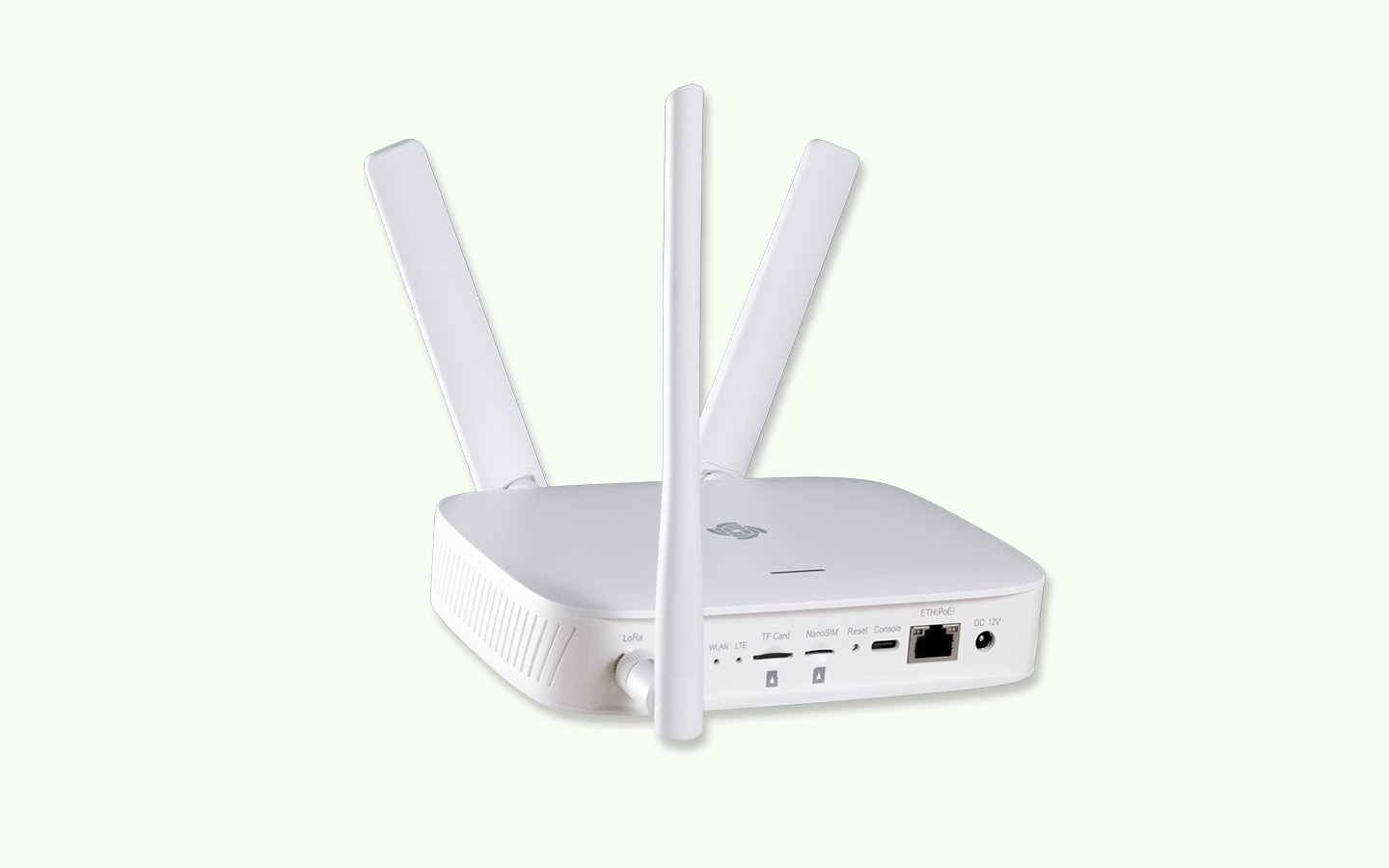
A gateway is a network device that acts as an intermediary between two different networks or transmission technologies. In building automation, it receives radio signals from end devices and forwards them via the internet to a central server; in the opposite direction, it transmits commands to the devices. It thus forms the bridge between the sensors and actuators in the building and the central platform where the data is processed.
What is a gateway?
A gateway acts as a bridge between the wireless network within the building and the network server where the data is processed. It collects signals from numerous sensors and actuators and consolidates them in one place. Without it, the end devices would be unable to transmit their data to the central platform, as their wireless technology is not directly internet-enabled.
How does a LoRaWAN gateway work?
In a LoRaWAN network, the gateway receives the energy-efficient radio signals from the end devices and forwards them to the network server, which makes the data available to the central application. It can serve many devices simultaneously. Some gateways can also be equipped with a mobile network connection, enabling them to operate independently of the building’s network. This reduces the integration effort, as no changes to the existing IT infrastructure are required.
How many gateways does a building need?
This depends on the size, construction, and materials of the building. The range of a gateway can be up to 500 metres indoors, although signal penetration through the building depends on the building’s structure. In small properties, a single gateway is often sufficient; for complex or large buildings, however, several are recommended to ensure reliable coverage of all areas.
In practice, the actual number of gateways required is determined prior to installation on the basis of the specific building. When it comes to planning, it is not just the floor area but, above all, the construction method and the materials used that play a key role, as solid walls, reinforced concrete or metal components attenuate the radio signal more significantly than lightweight partition walls. For this reason, coverage is usually tested on site before the final number of gateways is determined. If a gateway can also be connected via mobile networks, there is no need to integrate it into the building’s network.
Related terms
Sources and further information
- Betterspace: Was ist LoRaWAN und wie funktioniert es
- Betterspace: better.energy at a glance
- Betterspace: Mit LoRaWAN zum Smart Building
- LoRa Alliance: What is LoRaWAN®?