



















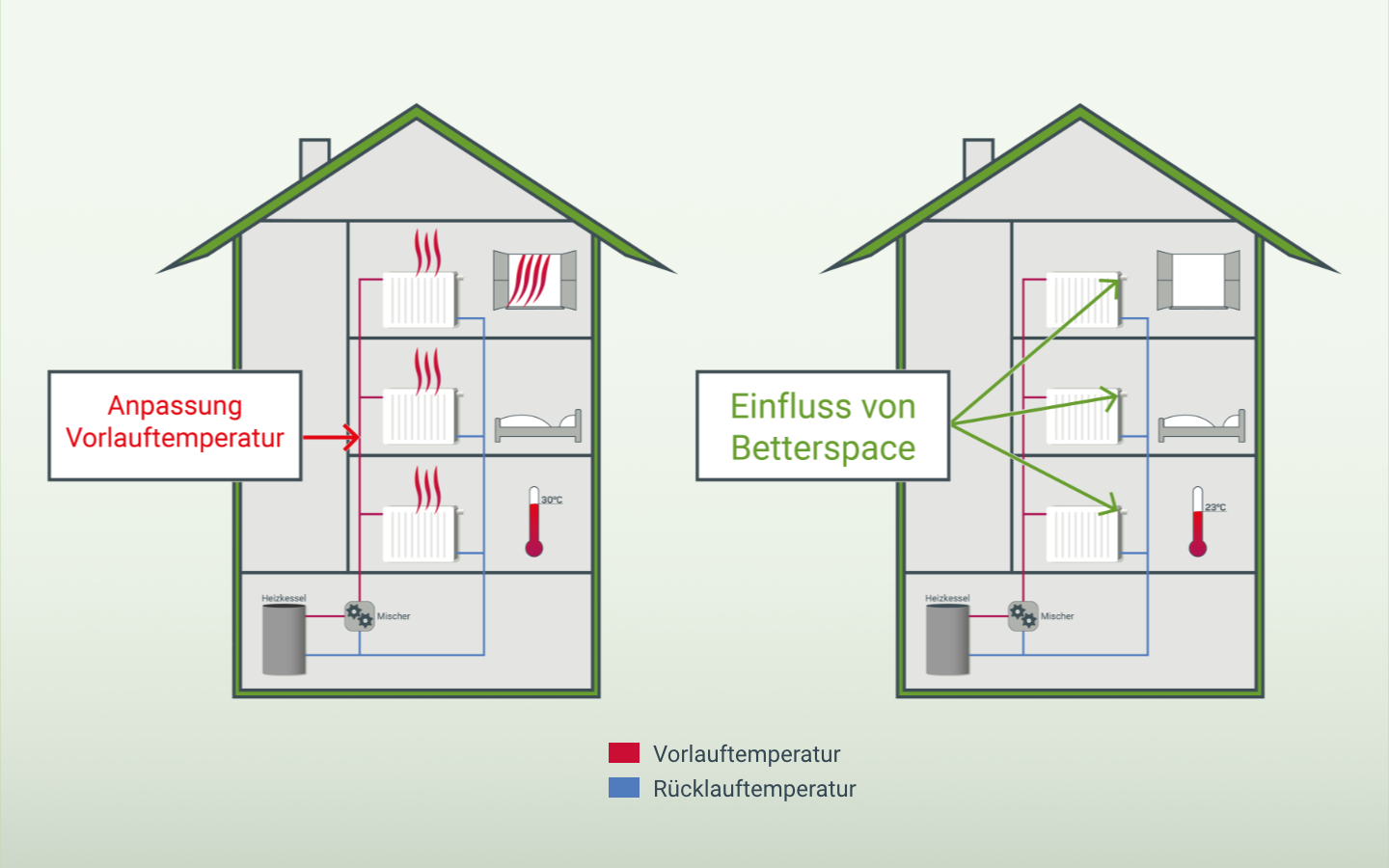
The flow temperature is the temperature of the heating water that flows from the heat generator to the radiators or underfloor heating systems. Together with the volume of water flowing through the system, it determines how much heat is transferred to the rooms. Conversely, the return temperature indicates how warm the water is when it returns to the heat generator. The flow temperature is therefore one of the key variables for the efficiency of a heating system and is typically controlled based on the outdoor temperature.
What is the flow temperature?
The flow temperature describes how hot the water is that the heating system sends to the radiators. The higher it is set, the more heat a radiator can give off. In a hot-water heating system, heat output is controlled by two factors: the flow temperature, which affects all rooms simultaneously, and the flow rate, which is regulated individually at each radiator via the thermostatic valve. These two factors are closely related because a change in the flow temperature affects all rooms.
How is the flow temperature related to the heating curve?
With weather-compensated control, the flow temperature is automatically adjusted to the outdoor temperature. This relationship is represented by the heating curve, also known as the heating characteristic curve: the colder it is outside, the higher the flow temperature. If the heating curve is set too steeply, the system heats more than necessary. If it is set too flat, the rooms will not get warm enough. A properly adjusted heating curve ensures that the system generates only as much heat as is actually needed, making it a key factor in efficient operation.
Why is a low flow temperature more efficient?
A lower flow temperature reduces heat loss during heat generation and distribution and is particularly beneficial for condensing boilers and heat pumps. However, it is important not to simply lower the flow temperature without considering the system as a whole. If individual rooms are not receiving enough heat, this is often not due to a flow temperature that is too low, but rather to uneven distribution of the heating water. The proper solution in this case is hydraulic balancing, not a blanket increase in the flow temperature. For automatic radiator control, a correctly set flow temperature is the foundation upon which the control system can function effectively.
Related terms
Sources and further information
- Betterspace: Die optimale Heizungsanlage, hydraulischer Abgleich und better.energy
- Betterspace: Hydraulischer Abgleich im Nichtwohngebäude
- Verbraucherzentrale: Heizung richtig einstellen und Vorlauftemperatur senken